Home › Road, Street, and Municipal Paving
Partner with a dependable contractor for road paving in Florida, FL. We construct and resurface neighborhood streets, access roads, and municipal lanes with attention to grading, compaction, and traffic control. Our team coordinates staging and phasing so residents can travel safely while work progresses.
Precision Asphalt Florida provides professional road paving throughout Florida, FL, Florida and the surrounding area. Our licensed, insured crew delivers safe, clean, on-time work with a free estimate before anything begins. Call (407) 250-7227 or request your free quote.
Road, Street, and Municipal Paving in Florida, FL
Public roads in Florida, FL deal with intense sun, sudden downpours, and heavy traffic. That combination can destroy a weak pavement structure in just a few seasons. Precision Asphalt Florida focuses on road, street, and municipal paving that is built specifically for our local climate and traffic patterns, not a generic design copied from another region.
When you hire us for road paving, you are getting detailed planning first, not just a crew and a paver. We start by evaluating existing conditions, including base material, drainage paths, curb and gutter condition, and underground utilities. Then we match the asphalt mix design, base thickness, and compaction standards to your actual use, whether it is a neighborhood street, a bus route, or a connector that carries heavy trucks.
Our goal is to help cities, HOAs, commercial park owners, and public agencies in Florida, FL spend resurfacing dollars wisely. We explain your options clearly, show you the tradeoffs between initial cost and pavement life, and schedule work in a way that respects residents, businesses, and emergency access.
How Professional Road Paving Actually Works
Quality road paving is not just a new black surface. It is a controlled process with checks at every stage.
1. Evaluation and core sampling: On municipal and high value streets we often recommend asphalt cores or test pits. This tells us how thick the existing asphalt and base are, whether there is trapped moisture, and if the subgrade is stable. Without this step, a resurfacing project can fail early because the old structure was not strong enough to support a new layer.
2. Design and scope: Using the evaluation, we recommend a specific solution: full reconstruction, partial-depth milling with resurfacing, or simple overlay where conditions allow. We choose an appropriate FDOT style mix (for example, a finer surface mix for low speed neighborhood streets and a coarser friction course for higher speed roads) and specify compaction targets.
3. Traffic control and staging: For city streets we coordinate lane closures, flagging operations, and work zones so emergency vehicles and residents can still move. On HOA and private roads we set clear access windows and alternate routes. This planning reduces delays and prevents unsafe situations at the work zone.
4. Surface preparation: We mill or plane existing asphalt as required, clean the surface thoroughly, repair soft or alligatored areas, and install or reset castings such as manholes and valve boxes to final grade. Tack coat is then applied to ensure a proper bond between old and new layers.
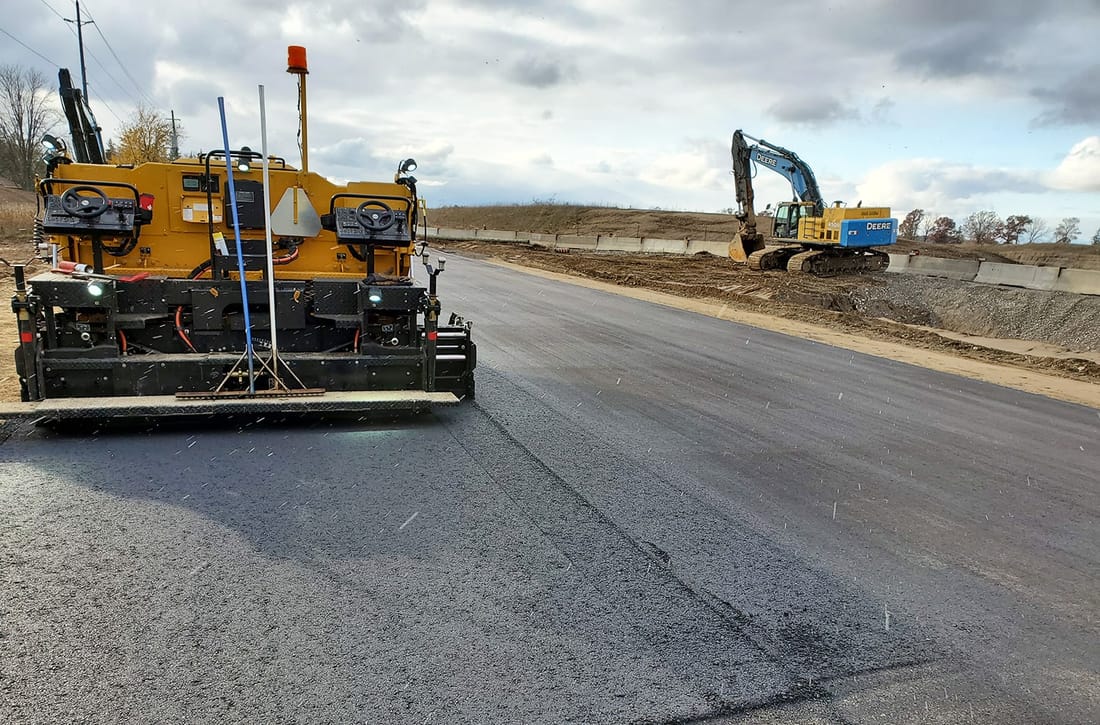
5. Paving and compaction: Asphalt is placed with a paver in a controlled mat thickness, then compacted immediately with a sequence of steel drum and pneumatic rollers. We monitor temperature, roller passes, and joint quality so you get a dense, uniform surface.
6. Final details and striping: After compaction and cooling, we fine tune transitions at driveways, re-stripe lanes and crosswalks, and reinstall signs and loop detectors where needed. The result is a smooth, safe, and clearly marked road ready for traffic.
Material Choices and Design Options for Florida Roads
In Florida, FL, the right asphalt design depends on more than traffic volume. Heat, UV exposure, and frequent wetting from storms and humidity affect which materials perform best and how thick each layer should be.
Asphalt mix selection: For many local streets, we recommend a dense-graded surface mix that balances smoothness with skid resistance. On higher speed or higher traffic roads we might specify a mix with a slightly coarser aggregate structure to improve friction during heavy rain, which helps reduce hydroplaning risk on flat sections common in Florida.
Layering strategy: For pavement that must carry buses, sanitation trucks, or delivery vehicles, we often design a thicker base and intermediate course, then a surface course in the 1 to 1.5 inch range. For light duty cul-de-sacs and HOA streets, we may recommend less total thickness but still maintain a strong base to handle garbage trucks and moving vans.
Drainage and cross slope: Effective drainage is critical in Florida storms. We design or correct cross slopes and crown so water clears the surface quickly, which reduces stripping and ravelling in the asphalt. Where needed, we recommend adding or improving swales, underdrains, or curb and gutter repairs to keep water away from the pavement structure.
Tie-ins and transitions: For city and county projects we pay special attention to rail crossings, intersections, and tie-ins to existing concrete sections. Proper saw cutting, stepped milling, and tactful use of leveling courses prevent bumps at transitions that can be dangerous for bikes and motorcycles.
Adaptation to local standards: Precision Asphalt Florida is familiar with common municipal and FDOT requirements, including mix specifications, compaction criteria, and inspection steps. We design our work so that it can be reviewed and accepted smoothly by engineers and inspectors who oversee public infrastructure in Florida, FL.
What Drives the Cost of Road Paving in Florida, FL
Two streets the same length can have very different costs. Understanding what affects pricing helps you plan budgets and compare proposals realistically.
Existing pavement condition: If the existing asphalt has deep structural failures or a weak base, the job may require full-depth reclamation or base replacement instead of simple resurfacing. These repairs cost more up front but usually avoid repeated patching and early failure.
Thickness and section design: Additional inches of asphalt or base rock add material and trucking costs, but they also extend pavement life. For example, increasing the base thickness on a bus route can significantly delay major rehabilitation. Precision Asphalt Florida will show you pricing for alternative sections so you can see how different choices affect both cost and expected life.
Traffic control complexity: Roads that require night work, full detours, or police details cost more than simple low-traffic neighborhood streets. Coordinating with local agencies, setting up advanced warning signage, and maintaining safe pedestrian routes add time and labor.
Access and phasing: Working around schools, hospitals, or busy commercial areas often means shorter work windows and more phases. While this protects users, it can increase cost because crews must mobilize more frequently.
Asphalt and fuel markets: Asphalt prices follow oil markets, and trucking and equipment costs change with fuel prices. For larger municipal projects we can often secure better pricing through bulk material planning if the work is scheduled strategically.
To keep your project on budget, we provide clear, itemized proposals that separate base repair, milling, paving, striping, and optional upgrades. This makes it easier for city managers, property managers, or boards to prioritize and phase work.
Common Road Problems in Florida and How We Fix Them
Local roads face predictable issues in Florida, FL because of heat, intense sun, and periodic heavy rain. Recognizing these problems early and repairing them correctly can add years to pavement life.
Alligator cracking and base failures: Interconnected cracking, often in wheel paths, usually means the base or subgrade has failed. Simply overlaying this area will not last. We saw cut the perimeter, remove failed material to a stable depth, rebuild the base with proper compaction, then patch with hot mix asphalt before resurfacing.
Rutting from heavy vehicles: Bus routes, garbage truck paths, and delivery routes can develop depressions. In these cases we analyze whether rutting is from mix instability or base failure. Solutions range from milling the rutted area and installing a more stable mix to deeper reconstruction in severe cases.
Ponding and drainage problems: Standing water accelerates pavement damage. We correct minor issues by profile milling to restore cross slope and crown. For more serious drainage problems, we may recommend regrading shoulders, adjusting inlets, or adding small valley gutters or flumes so water has a clear path off the roadway.
Raveling and UV damage: Over time, aggregate may loosen from the surface, especially where older mixes were used or where regular maintenance was skipped. Depending on severity, we may recommend a thin overlay, a leveling course plus new surface, or targeted patching in combination with resurfacing.
Utility cut deterioration: Badly repaired utility trenches often become rough spots or early failure zones. We re-cut these areas with straight edges, stabilize the base, and compact asphalt in lifts so the repair performs like the surrounding road.
By addressing the root cause instead of just the symptom, Precision Asphalt Florida helps municipal and private road owners reduce long term maintenance costs and avoid repeated emergency repairs.
Project Planning, Scheduling, and What to Expect
Successful road, street, and municipal projects in Florida, FL depend on clear communication and efficient scheduling. Precision Asphalt Florida works closely with public works departments, engineers, property managers, and boards to plan each step.
Pre-construction planning: We review your existing plans or help you create a simple scope with priorities and phasing. For HOAs and private communities, we often assist with pavement condition walks and basic pavement management recommendations so you can spread improvements over several years instead of doing everything at once.
Resident and stakeholder notifications: Before work begins, we can provide notices and maps that show dates, times, and parking or access restrictions. This is especially important for communities with many residents, school pickup and drop-off areas, and busy downtown blocks.
Work timing and weather: Because of Florida weather, we schedule most paving when rain risk is lower and surface temperatures are favorable for proper compaction. When storms are expected, we adjust work sequences to avoid leaving milled surfaces exposed longer than necessary and to protect open areas from water damage.
Safety and access: Throughout the job we maintain safe access for emergency vehicles and coordinate with you on any needed closures. Detour routes and flaggers keep traffic moving while protecting workers and the public.
Post-project support: After completion, we walk the project with you to confirm that drainage, joints, striping, and transitions meet expectations. We can outline a simple maintenance plan so you know when to consider crack sealing, localized repairs, or future resurfacing.
If you manage roads or streets in Florida, FL and need a partner who understands both the technical side of paving and the real-world impact on residents and users, Precision Asphalt Florida is ready to help you plan and execute a project that lasts.